The second in a series of articles describing the practical use of digital technologies (AI + cloud) and Financial Data Intelligence in market analysis and trading. The main theme is an example of using predictive AI in an attempt to anticipate sudden price changes in futures contracts based on the analysis of Commitments of Traders (COT) Reports
A successful speculator plays a waiting game. Most people cannot wait; they would rather wager, and the sooner the better. Speculator kings and queens have the patience to put off taking action until the tumblers have clicked into place, knowing that profits are then more likely to prevail.
Larry Williams Long-Term Secrets to Short-term Trading | 2nd edition 2012
Intro
From graph papers to Predictive AI
…in other words: the last five decades of Commitments of Traders (COT) Reports analytics
In 1979, Larry Williams published the book “How I Made One Million Dollars Last Year Trading Commodities” in which he described how he created his strategies using analog charts that represented the positioning of Smart Money on graph paper, which he then turned into success.
Then came Stephen Briese, who introduced concepts such as the Movement Index and combined technical analysis with COT data.
The topic of COT reports is quite popular overseas, some well-known traders, regardless of their market method, refer to COT analytics as a reliable source for potential trading scenarios.
In Poland, COT data is still a niche topic. Few traders and stock market analysts show how to use COT reports in market analysis.
The last decade has brought a whole new dimension to COT analytics, with AI and cloud technology drastically “adding wings” to the way COT data is analyzed.
In this article, I will present my approach to using AI to decode Smart Money intentions by extracting them from COT data.
What are COT reports/data?
Commitments of Traders (COT) Reports are weekly statistics compiled by the CFTC (Commodity Futures Trading Commission) on the NET positions (the number of Long and Short contracts) on specific goods, commodities, indices, currencies, etc., held by different market participant groups: Smart Money (Commercials and Non-Commercials traders), and the non-reportable group (retail traders).
I will refer to the classification (Smart Money) of CFTC (Commodity Futures Trading Commission), although you can find different interpretations in the literature:
-
Smart Money:
- Commercials Traders use financial instruments to hedge their business activities. In this group, there may be a producer of some commodity, an international corporation hedging its currency operations, etc. We are talking about “big money” in terms of market positions.
- Non-Commercials, the other side of Commercial Traders, is driven mainly by profit, just like the “retail traders”.
-
Dumb money: Retail traders and investors trading with their own means. Mostly people without appropriate preparation, acting under the influence of impulse (news, geopolitical event), emotions, without a defined trading strategy.
The weekly report (below) shows the positioning for a particular week, but this information is insufficient for us to assess the potential relationship with the price in a given market. If we create a time series from this, we can observe how the positioning of various market participant groups changed over time. This is our starting point for further analysis.
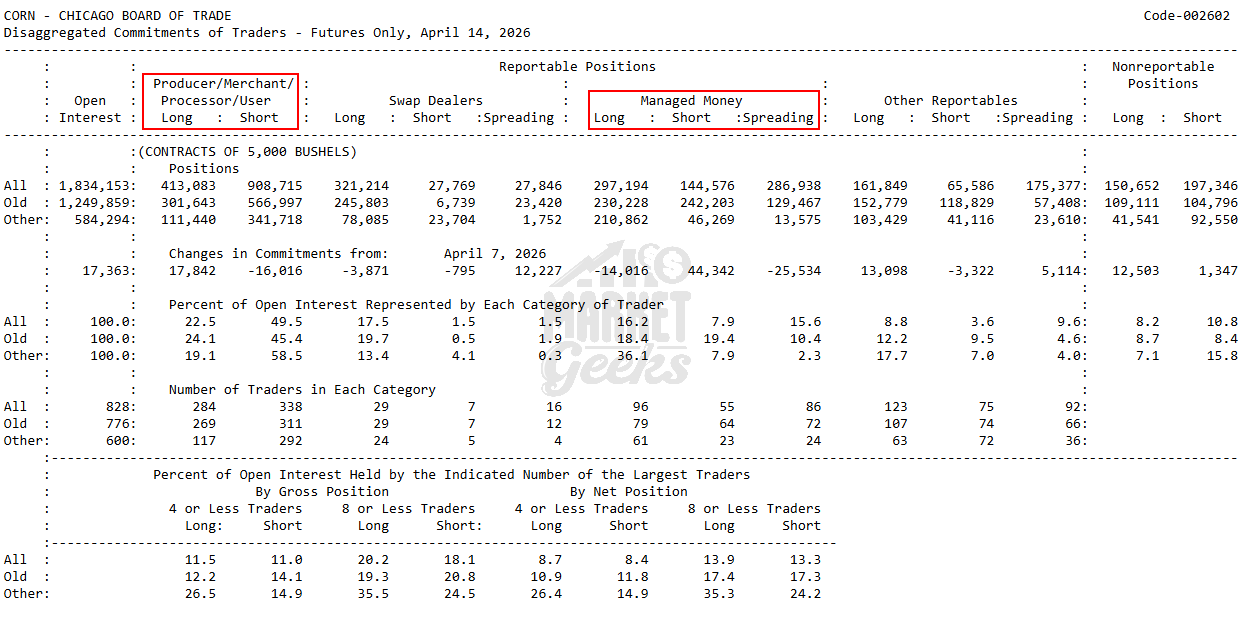
- Source: Reports Dated April 14, 2026 - Current Disaggregated Reports. Retrieved April 23, 2026, from https://www.cftc.gov/dea/futures/ag_lf.htm
The chart below shows the market participants’ positioning (Commercials, Non-Commercials, and non-reportable) for the Soybean Meal contract.

- For more information, please consult the literature and the Commodity Futures Trading Commission (CFTC). https://www.cftc.gov/MarketReports/CommitmentsofTraders/index.htm
“Catching new trends” with AI
Anyone who has worked with classical machine learning, built CNN networks, or trained AI models knows that the quality of input data significantly impacts the final results. COT reports are high-quality data that are perfectly suitable for AI work.
AI helps in assessing the market situation.
I started experimenting with AI a few years ago. I almost instantly chose financial data, especially publicly available data that can be processed in any way
In recent years, thanks to experiments with predictive AI, I developed an “indicator” that allows me to determine the start or end of periods when Smart Money (commercial traders) may have a significant influence on the price behavior of a given commodity.
Strength, Weakness, and “Transient”
AI helps me identify three periods when Smart Money (Commercial Traders) can have a real impact on prices.
- Strength - a period when Smart Money can support a potential price growth.
- Weakness - a period when Commercial Traders can negatively impact a potential price growth.
- Transient - the time of the end of the weakness or strength period, which can entail potentially significant upcoming price (trend) changes, etc., or entering another period of weakness or strength.
Below, I present examples of three different markets where I will discuss these observations in more detail. Let’s note that the AI performs this task quite well across various commodity categories (metals, softs, and grains).
KGHM Company (Warsaw Stock Exchange) | Year 2024 (April - July)
(context based on the copper contract traded on COMMODITY EXCHANGE INC.)

Situational Context
It is the beginning of April 2024, and KGHM is breaking out of a one-year consolidation period. However, significant anomalies in the COT data occurred a few weeks before the “train’s departure.” The animation below illustrates the described period along with the transactions made.
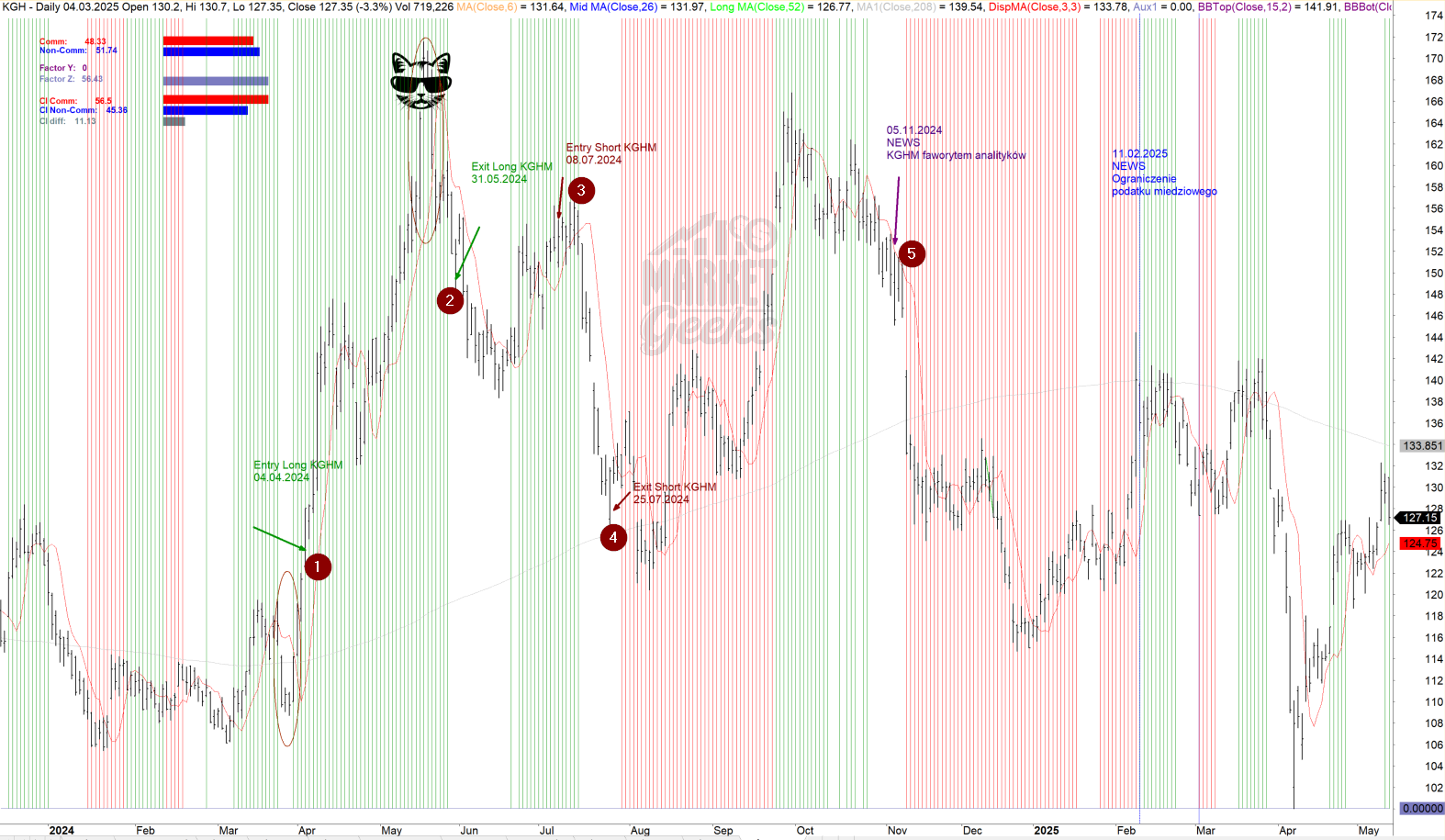
In relation to the above chart.
- (1) After a short transient period, the time of strength begins (green vertical lines) in early April 2024, which lasts until the end of May 2024. On April 4, 2024, a long position in KGHM was opened as part of a multi-element transaction plan.

- (2) Towards the end of May 2024, the period of strength ends, transitioning into a “transient.” The price drops below the local peak. This concludes the Long position on May 31.
- (3) In early July 2024, another period of strength ends, transitioning into a transient. This results in opening a Short position on KGHM on July 8.
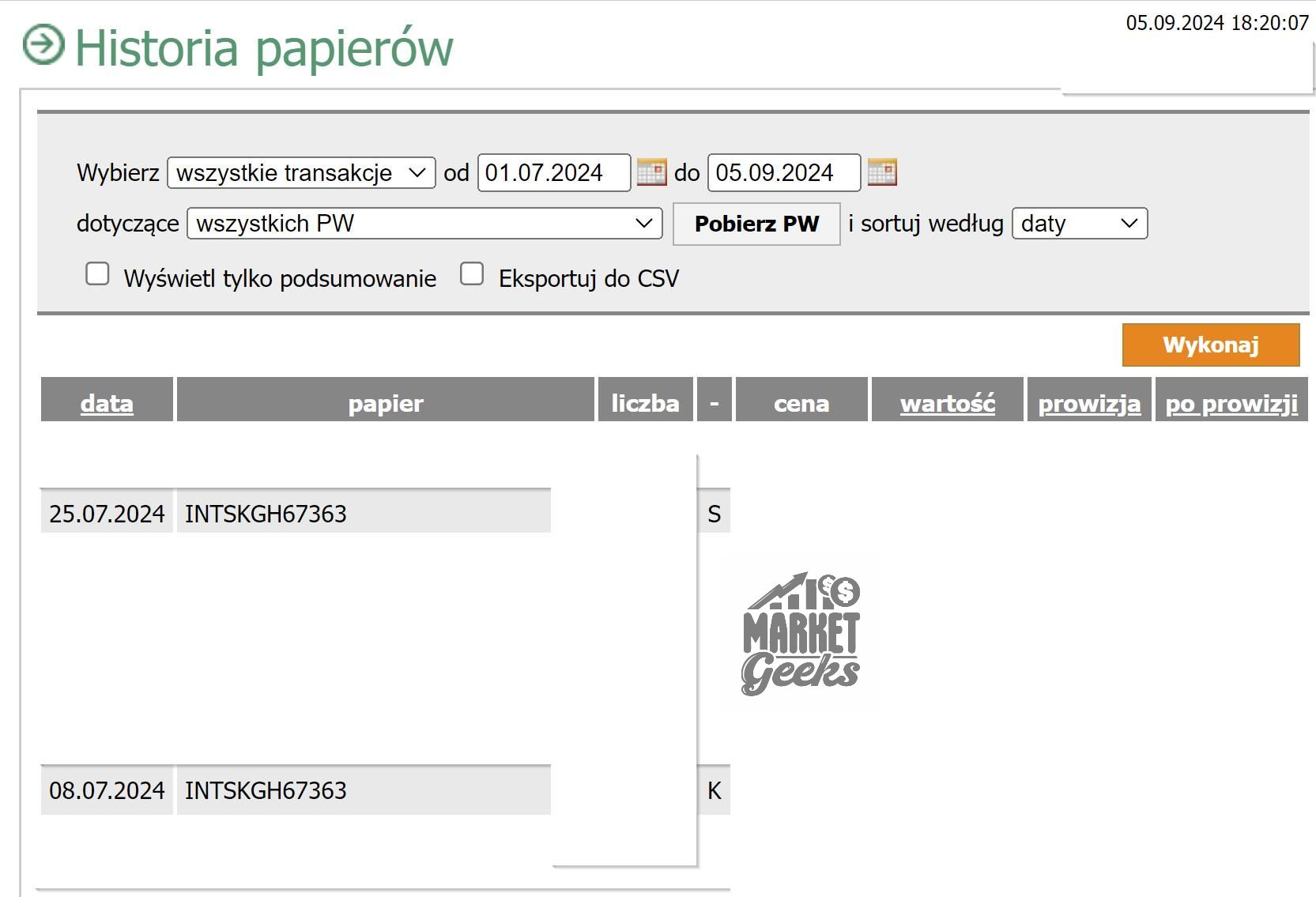
- (4) July 25 is the closure of the KGHM Short position with a profit. Shortly afterward, a period of weakness begins.
- (5) For dessert: On November 5, 2024, a press article appears that presents KGHM in a very positive light. A few days later, a period of weakness begins (red vertical lines), during which the company experiences a “price drop.”
The “indicator” described here was only one of the ancillary elements of the transaction plan, which was detailed in a previous article. https://marketgeeks.pl/en/posts/articles/2025/cyfrowe-gornictwo-miedzi/
Coffee | End of a Bull Market (January - February 2025)

Situational Context
The last quarter of 2024 marked the beginning of a surge in coffee prices, which peaked in February 2025. In September 2024, news reported a drought in Brazil and Typhoon Yagi in Vietnam.
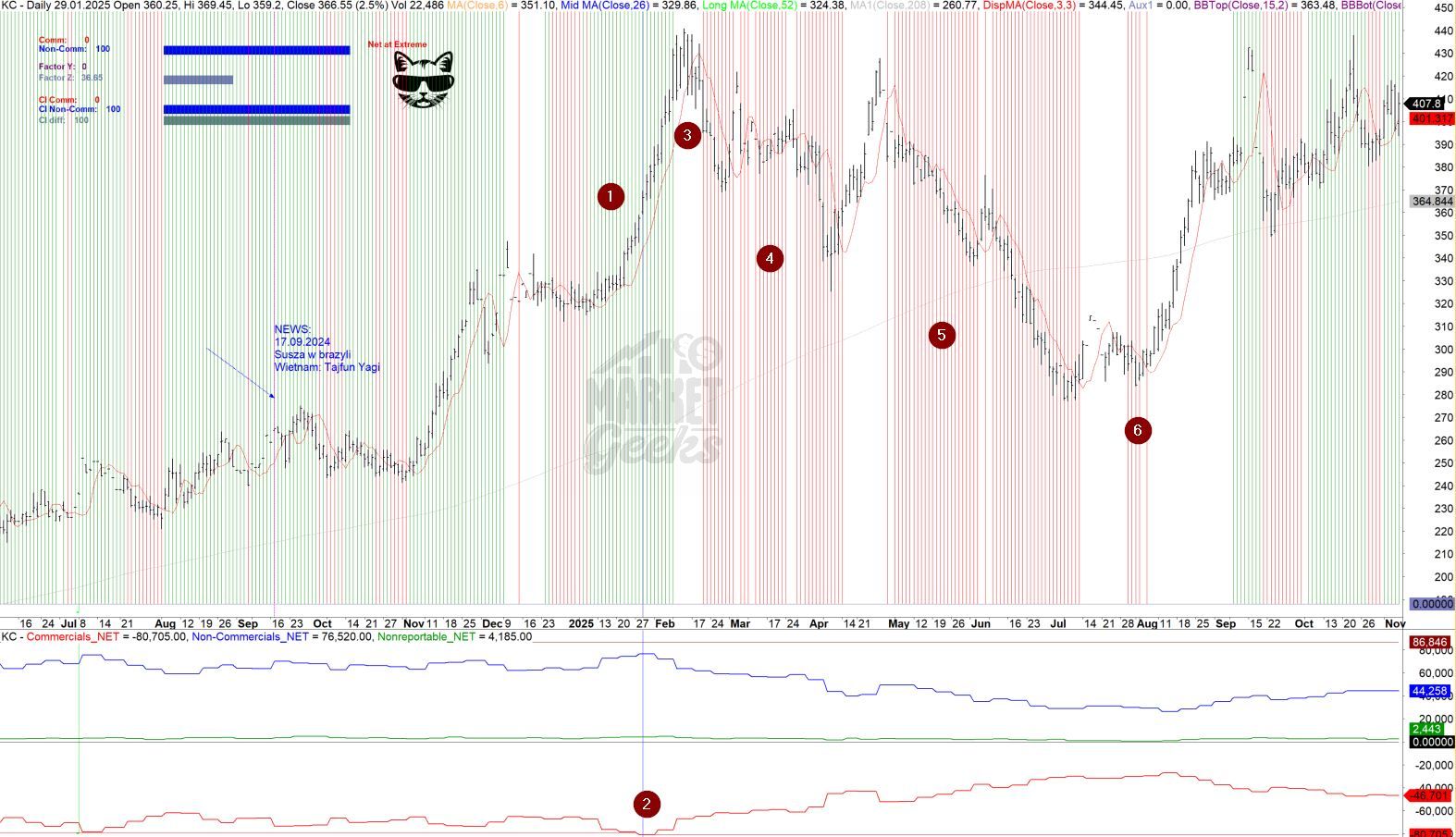
- (1) The start of 2025 is the second wave of rising coffee prices. At this time, AI indicates a period of “strength.”
- (2) Behind the scenes, the NET Short Commercials position reached a historical All-Time High (at the end of January 2025), and has remained in force to this day.
- (3) In mid-February 2025, the coffee price reached a historic peak.
- Then, between February and April (4), and May and July (5) in 2025, the price is only going down. AI is clear about the periods of weakness during this time.
- Following a brief “weakness” period in August 2025 (6), the price rapidly increases.
Soybean Meal (second half of 2025)

Situational Context
Throughout 2025, Soybean Meal prices have been weak. After a series of local minima in October 2025, a breakthrough is about to happen.
However, before that, the Commercial Traders are building the largest long NET position in history at the beginning of August 2025.
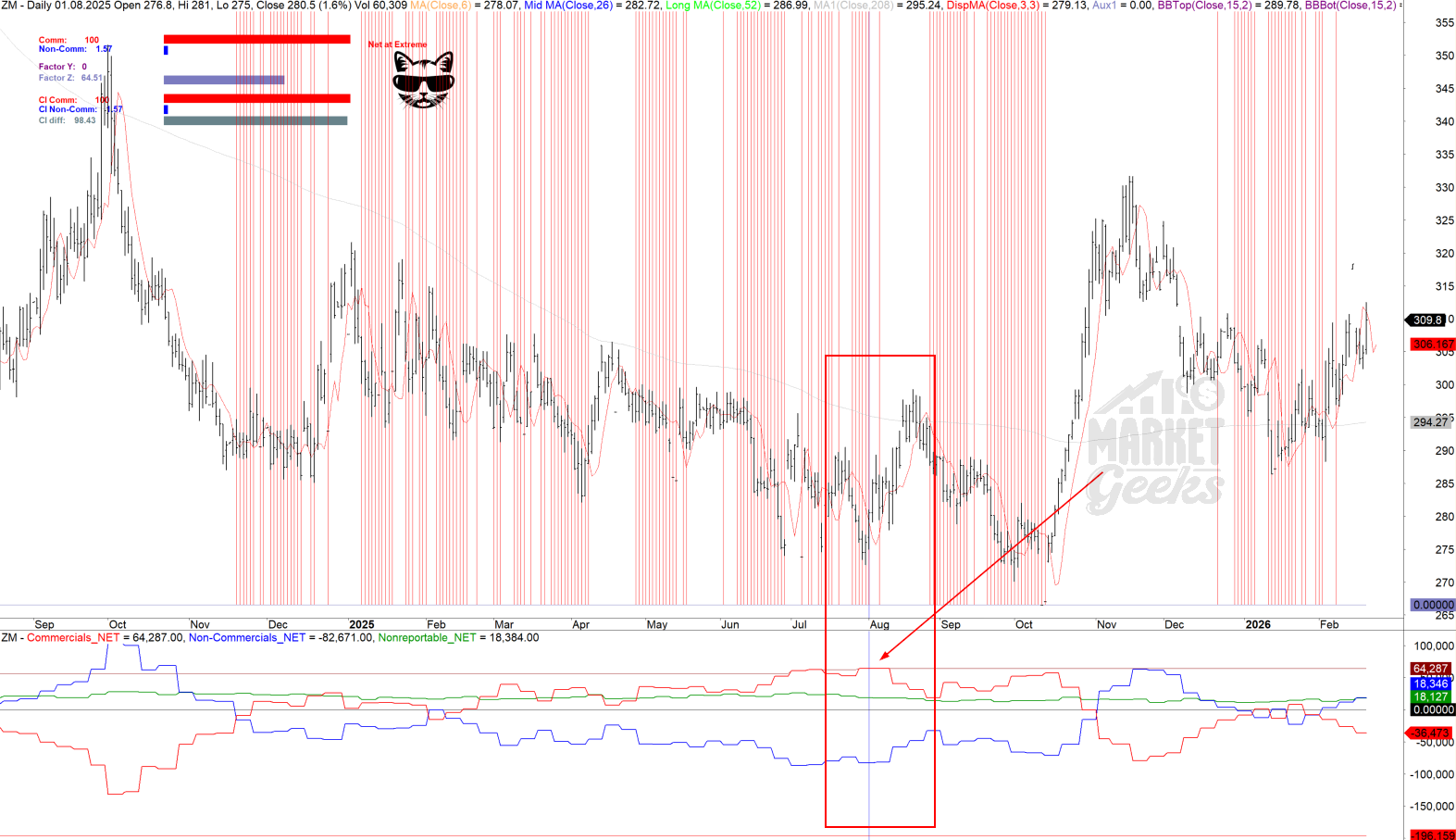
As shown in the chart below, the Commercial Traders were NET Short most of the time until 2025, when they significantly crossed 0, transitioning into NET Long.
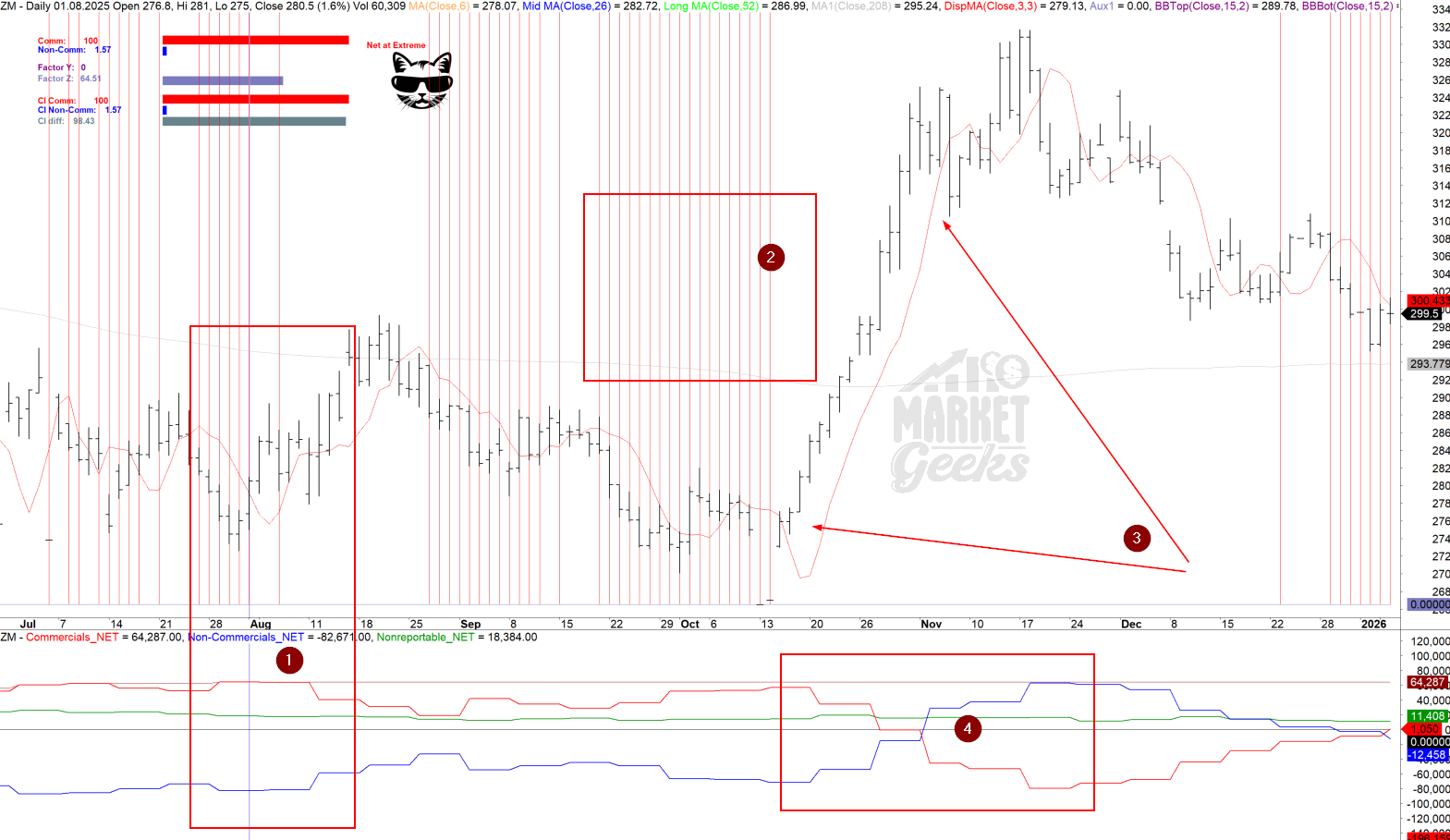
- Beginning of August 2025: (1) Commercials Traders are building the largest NET Long position in history.
- In mid-October 2025, the period of weakness identified by AI ends (2). Almost immediately, a strong upward trend begins (3).
- Large repositions of Commercial Traders occur during this rise (4).
Who Controls Commodity Prices?
I already answered this question for myself.
My own COT analysis and work with AI made me realize what really affects commodity prices, what to pay attention to when analyzing COT data, and the role Commercial traders play in this.
Outro
Editorial Note
- The second edition of the article took place on April 27th, 2026.
- Stock charts and animation (bar replay) were generated in AmiBroker software.
Disclaimer
- The information provided in this article is not intended as investment advice. It is crucial to conduct your own research and, if possible, perform backtesting before engaging in any trading activities.
- The content presented in this article is for educational purposes only and should be understood as such. These are the private opinions of the author, and in no way, in part or in entirety, constitute investment recommendations.
- Prior to making any financial decisions, it is strongly recommended to seek guidance from a registered investment advisor.
- The author is not responsible for investment decisions made on the basis of the content presented here, nor for losses that they may have caused.
- The content presented should not be understood as an incentive to invest or speculate financially.
Copyright Disclaimer
The content of this article is protected by copyright law. Unauthorized use, reproduction, or distribution of any part of this content without written consent is strictly prohibited. Written permission must be obtained before any utilization of the material.
Editorial team